
Organic traffic was already moving in the wrong direction when this digital publishing platform came to us.
The problem wasn’t a temporary dip or a single bad month.
Traffic had been declining consistently, with no obvious indication of where the bottom was.
At the beginning of the engagement, the website was generating roughly 9,410 monthly organic clicks and 937,000 search impressions.
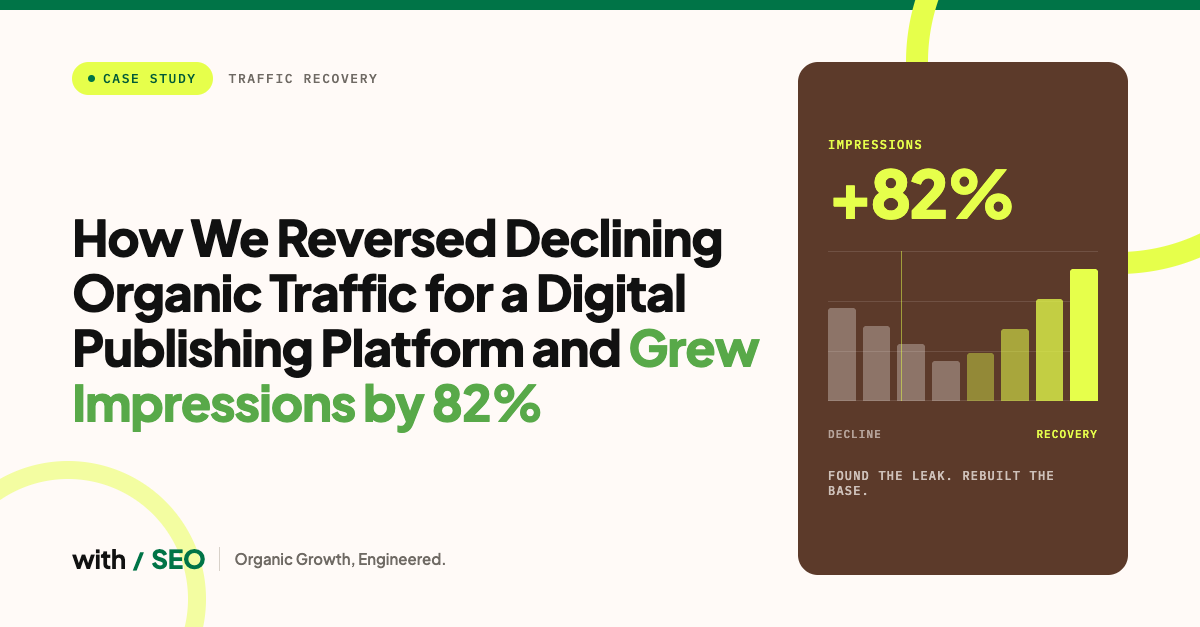
Twelve months later, monthly clicks had recovered to approximately 11,000, while impressions had grown to 1.71 million.
That meant:
- +17% growth in monthly organic clicks
- +82% growth in monthly search impressions
- A declining organic trajectory had turned into a growing one
But the recovery didn’t come from simply publishing more content.
The bigger problems were already sitting inside the website.
Multiple pages were competing against each other for the same keywords across three important content clusters, while years of accumulated technical SEO issues were making it harder for search engines to efficiently crawl the site.
So instead of adding more pages to an already complicated setup, we focused on removing the things holding the existing website back.
About the Client
The client is a digital publishing platform with an established organic search presence and a substantial library of content.
Three topic areas were particularly important to its organic strategy:
Ebook, Epub and DRM.
These weren’t new topics for the website. The client had already created significant content around them.
That was part of the challenge.
Over time, multiple pages had started targeting similar or overlapping queries. Instead of strengthening the website’s authority around these topics, some of those pages were competing against one another.
At the same time, the site had accumulated significant technical debt.
So this wasn’t a case of building an SEO channel from scratch.
The challenge was arguably harder:
Take an established organic channel that was losing ground, understand why it was declining and turn the trajectory around.
The Starting Point: Organic Traffic Was Already Declining
When the engagement began, the website was generating approximately:
- 9,410 monthly organic clicks
- 937,000 monthly search impressions
But the numbers alone didn’t tell the full story.
The important part was the direction they were moving.
Organic performance was steadily declining.
When this happens, one of the most tempting responses is to increase content production.
Publish more blogs.
Target more keywords.
Create more landing pages.
Try to compensate for lost traffic by increasing the number of pages capable of generating it.
But that approach can make an existing problem worse.
If multiple pages already compete for the same query, publishing another similar page adds another URL to the competition.
And if search engines are already wasting crawl resources following redirect chains, outdated internal links and broken paths, adding hundreds of new URLs does not fix the underlying problem.
So before deciding what new content the website needed, we investigated what was preventing the existing content from performing properly.
Two issues stood out.
Keyword cannibalization and technical debt.
The First Problem: Three Important Content Clusters Were Cannibalizing Themselves
We started by auditing the three core content clusters:
- Ebook
- Epub
- DRM
Across all three, we found pages competing against one another for the same or very similar queries.
Keyword cannibalization is often described simply as “two pages targeting the same keyword.”
In practice, it is more nuanced.
The real problem appears when search engines have multiple URLs that appear suitable for the same search intent, but there is no clear signal indicating which page should be considered the primary result.
Instead of one strong page accumulating relevance and authority, signals become fragmented across several URLs.
That was happening here.
So we mapped the pages within each cluster against the queries they were competing for.
We then identified:
- Pages targeting overlapping search intent
- URLs competing for the same queries
- Stronger pages that should become the primary target
- Weaker or redundant pages that no longer needed to exist independently
From there, overlapping pages were consolidated.
The strongest page within each group became the clear search target.
Where appropriate, weaker duplicate pages were redirected or removed.
The objective was simple:
One clear page should own an important search intent instead of three pages fighting over it.
This gave each content cluster a much cleaner structure and reduced internal competition.
The Second Problem: More Than 4,000 Technical SEO Issues
Content cannibalization was only one part of the problem.
A site-wide technical audit surfaced more than 4,000 individual issues across six high-priority categories.
These weren’t cosmetic warnings that existed only inside an SEO crawler.
Many directly affected how efficiently search engines could navigate the site.
The technical issues included:
| High-priority issue | Scope | Status |
| Internal links pointing to redirects | 3,503 links | Fixed |
| Redirect chains | 511 chains | Fixed |
| HTTPS pages redirecting to HTTP | 141 redirects | Fixed |
| Internal links pointing to broken pages | 10 links | Fixed |
| Redirected JavaScript files | 10 files | Fixed |
| 301 redirects included in the sitemap | 8 entries | Fixed |
The largest issue alone involved 3,503 internal links pointing to redirected URLs.
That meant users and search-engine crawlers were repeatedly being sent through unnecessary redirects instead of directly to the final destination.
We replaced those redirecting internal links with their final URLs.
We also:
- Untangled redirect chains
- Fixed internal links pointing to broken pages
- Corrected HTTPS-to-HTTP redirect behaviour
- Version-pinned redirected JavaScript files
- Removed redirect URLs from the sitemap
Each issue might appear small when viewed individually.
Across an entire website, however, they create friction.
Search-engine crawlers spend time following unnecessary redirects, retracing chains and reaching URLs that should no longer be part of the site architecture.
By resolving the technical debt, crawl activity could be concentrated on the pages that actually mattered.
We Then Refocused the Pages That Survived
De-cannibalization wasn’t simply about deleting or redirecting pages.
Once we determined which URLs should remain, those pages had to become stronger search targets.
So we refined the surviving content around its intended query.
That included improving:
- Search intent alignment
- Page structure
- Readability
- Query targeting
- Relevant keyword variations
This was an important part of the process.
Consolidating three weak overlapping pages into one page doesn’t automatically create a strong result.
The remaining page still needs to clearly satisfy the search intent it is supposed to own.
So rather than treating consolidation as the final step, we treated it as an opportunity to create a more focused destination.
The result was a simpler content architecture:
fewer competing pages, clearer search targets and stronger surviving URLs.
The Results: From a Declining Channel to a Growing One
The engagement ran for approximately twelve months.
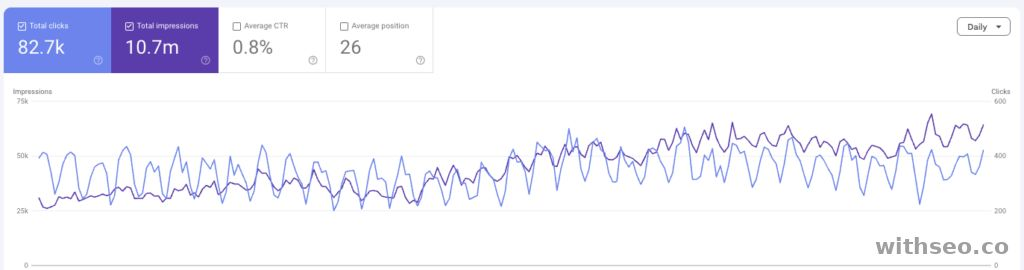
Google Search Console data across the whole website showed 82.7K clicks and 10.7 million impressions during that period.
More importantly, the direction of the trend changed.
When we started, organic performance was declining.
By the end of the period, it was growing.
| Metric | When we started | Now | Change |
| Traffic trajectory | Declining | Growing | Reversed |
| Monthly organic clicks | 9,410 | 11,000 | +17% |
| Monthly search impressions | 937,000 | 1,710,000 | +82% |
The headline improvement is the growth in visibility.
Monthly search impressions increased from approximately 937K to 1.71M.
That is an 82% increase.
Monthly organic clicks recovered from approximately 9,410 to 11,000, representing 17% growth.
But the most meaningful result was arguably simpler:
The decline stopped.
The organic channel had gone from consistently losing ground to gaining it again.
Why Did Impressions Grow Faster Than Clicks?
An 82% increase in impressions alongside 17% click growth naturally raises a question.
Why didn’t clicks grow at the same rate?
Because the website’s search footprint expanded faster than that new visibility could fully convert into traffic.
After cleaning up the content clusters and removing technical friction, the site began appearing across a broader set of searches.
Not all of those new impressions immediately came from top-ranking positions.
That is normal during this stage of recovery.
Visibility can expand first.
Those newly visible queries can then move higher over time and contribute progressively more clicks.
This is why looking at one metric in isolation can create the wrong conclusion.
If we had looked only at clicks, we would have seen a 17% increase.
Useful, but not extraordinary.
When paired with the 82% growth in impressions and the reversal of a long-running decline, a much clearer picture emerges.
The website had started rebuilding its organic search footprint.
Why Fixing Cannibalization and Technical SEO Worked Together
There is another important lesson from this project.
A declining organic channel rarely declines because of one isolated problem.
Here, fixing only the technical issues would have left multiple pages competing against each other.
Fixing only the cannibalization would have left search engines navigating thousands of unnecessary redirects and hundreds of redirect chains.
The improvements worked because both sides of the problem were addressed.
On the content side, we clarified:
Which page should rank for which search?
On the technical side, we clarified:
How should search engines efficiently reach those pages?
Those two questions are closely connected.
SEO becomes significantly harder when a website has both an unclear content architecture and an inefficient technical architecture.
The work was therefore less about finding one “SEO hack” and more about removing several brakes at the same time.
What This Means for Other Established Websites
This case study has a different lesson from the typical “how we grew organic traffic” story.
Sometimes the biggest SEO opportunity isn’t creating something new.
It is understanding what has accumulated over years of publishing.
Audit cannibalization before expanding important clusters
If you already have dozens of pages around an important commercial topic, don’t assume you need another one.
First understand what the existing URLs rank for.
Look for overlapping intent and situations where several pages repeatedly appear for the same queries.
In some cases, consolidation may be more valuable than another content brief.
Don’t ignore redirecting internal links
A redirect may work technically, but that doesn’t mean your own internal links should continue pointing to it indefinitely.
Where possible, update internal links so they point directly to the final destination.
At scale, this creates a cleaner and more efficient site architecture.
Treat technical SEO debt as something that compounds
Redirect chains, broken internal links, sitemap inconsistencies and protocol issues rarely appear overnight.
They accumulate.
And large established websites tend to accumulate more of them simply because more pages, migrations and site changes have happened over time.
Periodic technical cleanup is therefore not just maintenance.
It protects the efficiency of the organic channel.
Give each important search intent one clear destination
More pages do not automatically create more authority.
Sometimes they divide it.
For strategically important queries, search engines should have a clear answer to the question:
Which page on this website is the best result?
If your own site architecture makes that difficult to answer, consolidation may be necessary.
Sometimes SEO Growth Starts by Removing What Is Holding the Site Back
When this engagement began, the website wasn’t starting from zero.
It already had substantial content, meaningful search visibility and established topic clusters.
But the organic channel was declining.
The solution wasn’t simply to publish more on top of what already existed.
We audited and de-cannibalized the Ebook, Epub and DRM clusters.
We resolved more than 4,000 technical SEO issues, including 3,503 redirecting internal links and 511 redirect chains.
We sharpened the intent of the pages that remained.
Over the engagement, monthly search impressions increased from approximately 937K to 1.71M, while monthly organic clicks recovered from 9,410 to 11,000.
Most importantly, the trajectory changed.
The site stopped consistently losing organic ground and started gaining it again.
For established websites, that is an important reminder:
Sometimes the next stage of SEO growth doesn’t begin with adding more pages. It begins by removing the friction from the ones you already have.
If your organic traffic is declining and you’re not sure whether the problem is content, cannibalization, technical debt or a combination of all three, we can help identify where the real bottleneck is. Book a free SEO teardown