
The client had a clear SEO ambition:
Rank on page one for “remote support,” one of the most important category terms for its business.
But the website wasn’t really built to compete for it.
The Remote Support content cluster had grown to more than 30 blog posts. Many were thin, several targeted overlapping search intent and some were still built around outdated years.
Underneath that sat another problem: 1,500+ technical SEO issues across seven high-priority categories.
So publishing another batch of content wasn’t going to solve the problem.
In many ways, content volume had become part of it.
We took a different approach:
Prune first. Fix second. Then publish with much sharper intent.
Twelve months later, the Remote Support blog cluster had reached an average Google Search position of 10.3 — effectively page one.
This SaaS SEO case study is the story of how fewer, more focused pages helped create a stronger path to a competitive category ranking.
About the Client
The client is a B2B SaaS platform operating in the remote support software space.
Remote support is an important category for the business, which made organic visibility around the term strategically valuable.
The company already had an established website and a significant content library.
So the problem wasn’t a lack of content.
Quite the opposite.
Over time, the Remote Support blog cluster had expanded beyond 30 posts. Some pages were useful, but others had become thin, outdated or too similar to other content already on the site.
The technical architecture had also accumulated debt.
That meant the engagement wasn’t about starting an SEO program from scratch.
It was about taking an existing content engine, removing what was holding it back and making the pages that remained more competitive.
The Starting Point: Volume Without Focus
A large blog can look like an SEO advantage.
Thirty-plus posts around a strategically important category sounds like strong topical coverage.
But page count alone doesn’t create topical authority.
When we audited the Remote Support cluster, we found several different problems.
Some pages were too thin to properly satisfy search intent.
Others covered almost the same topic as another post and were effectively competing against each other.
Several older guides still referenced previous years, making them increasingly stale.
And some content simply wasn’t performing strongly enough to justify remaining indexable in its existing form.
This is a common stage in mature SaaS content programs.
The team has been publishing consistently for years.
The library gets larger.
But organic growth doesn’t necessarily follow.
The default reaction is often to keep publishing until something works.
Another keyword.
Another blog.
Another variation of a topic already covered three times.
That can create a bigger content library without creating a stronger search presence.
Volume without focus becomes a tax on your best pages.
Before we created more content, we needed to understand what the existing cluster was actually contributing.
The Two Blockers Holding the Site Back
Two issues became clear during the audit.
1. Content Sprawl
The Remote Support cluster had grown beyond the point where every page had a clearly differentiated role.
There were:
- Thin pages that did not fully satisfy search intent
- Near-duplicate articles targeting similar queries
- Pages cannibalizing each other
- Ageing guides still targeting outdated years
- Content that existed but contributed little organic value
Content cannibalization happens when multiple pages on the same website compete for substantially the same query or search intent.
Instead of creating one obvious page for Google to rank, the website sends several competing signals.
That doesn’t mean every page targeting related keywords should be consolidated.
But it does mean every page should have a reason to exist independently.
In this cluster, too many did not.
2. Technical Debt
The content problem was happening alongside a large technical one.
Our audit identified more than 1,500 issues across seven high-priority categories:
- Internal links pointing to dead pages
- Long redirect chains
- Orphan pages
- Hundreds of indexable pages missing from the sitemap
- Site-wide tracking parameters muddying the internal architecture
- Broken links
- HTTPS not being consistently forced
An orphan page is a page with no meaningful internal links pointing to it.
Search engines may still discover it through a sitemap or another source, but the site architecture gives them very little context about its importance or relationship to other pages.
We also found several areas where crawl budget was being wasted.
Crawl budget is essentially the number of URLs a search engine is willing to fetch from your website within a given period.
Every broken URL, unnecessary redirect hop or noisy parameterised URL can consume part of that attention.
For a growing SaaS website, those inefficiencies compound.
So we had two problems happening simultaneously:
The content architecture wasn’t focused enough.
And the technical architecture wasn’t clean enough.
What We Did: The Three-Part Fix
We approached the work in a deliberate order.
Prune. Fix. Then publish.
1. We Pruned the Remote Support Cluster
The first step was to audit every post within the Remote Support content cluster.
Rather than treating all pages equally, we scored them across four dimensions:
- Search intent
- Readability
- Cannibalization
- Organic performance
The goal was not to delete content simply because it was old or underperforming.
The goal was to determine whether each page still earned its place in the cluster.
Low-value and duplicate pages were noindexed where appropriate.
Overlapping posts were consolidated.
The remaining pages were prioritised for updates.
This immediately changed the structure of the cluster.
Instead of dozens of pages competing for attention, the site had a more deliberate set of URLs with clearer individual roles.
The objective was a leaner cluster where every page pulls its weight.
That also gave the strongest pages a better chance of consolidating authority rather than sharing signals with weaker near-duplicates.
2. We Cleared 1,500+ Technical SEO Issues
Once the content structure was clearer, we worked through the technical backlog.
All seven high-priority categories identified during the audit were addressed.
We:
- Removed and corrected broken internal links
- Reduced unnecessary redirect hops
- Connected orphan pages back into the site architecture
- Rebuilt and cleaned up the sitemap
- Forced HTTPS consistently
- Version-pinned redirected scripts
- Removed site-wide tracking parameters that were muddying the internal architecture
The individual fixes might not sound as exciting as publishing a new landing page.
But they changed how efficiently search engines could move through the website.
Before the cleanup, crawlers could spend time following redirects, reaching broken destinations or discovering URLs through inconsistent pathways.
Afterwards, the architecture provided cleaner signals.
Crawl budget stopped leaking into noise.
This was an important part of the ranking improvement because content and technical SEO are not separate systems.
A strong article still sits inside a website architecture.
If that architecture makes the article harder to discover, contextualise or revisit efficiently, the content starts at a disadvantage.
3. We Published With Sharper Search Intent
Pruning the content library didn’t mean we stopped publishing entirely.
It meant new content needed a stronger reason to exist.
Once the existing cluster was cleaner, we expanded it with content closer to commercial decision-making.
That included more comparison and decision-stage content.
Instead of adding more generic top-of-funnel posts simply to increase publishing volume, we focused on queries people were more likely to use when actively evaluating remote support solutions.
The principle was:
Publish where the demand is closest to a decision.
This gave new pages a clearer role within the cluster.
The site wasn’t publishing for the sake of maintaining an editorial cadence.
It was filling specific search-intent gaps identified during the audit.
That distinction matters.
Keyword research tells you what people search for.
A content strategy should also tell you why your website needs a separate page for that search.
The Results: Page One in 12 Months
Across the 12-month engagement, the client’s Google Search Console data showed:
| Metric | 12-Month Result |
| Whole-site impressions | 1.09M |
| Whole-site clicks | 12,400 |
| Blog cluster impressions | 834,000 |
| Blog cluster clicks | 1,710 |
| Blog cluster average position | 10.3 — page one |
The Remote Support blog cluster alone generated approximately 834,000 impressions over the period.
More importantly, its average position reached 10.3.
That placed the cluster at the edge of page one for the category the business wanted to compete in.
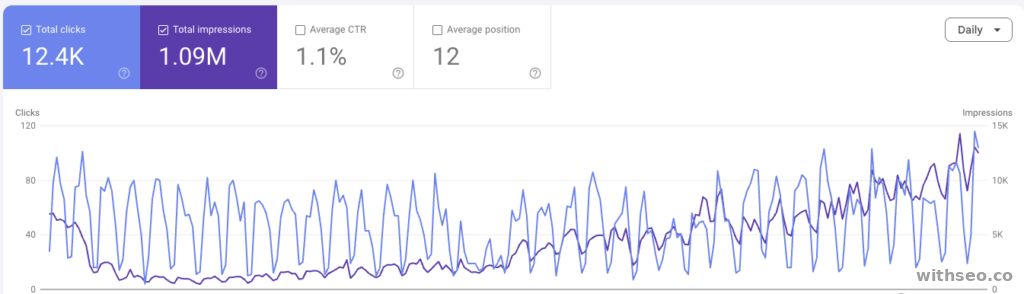
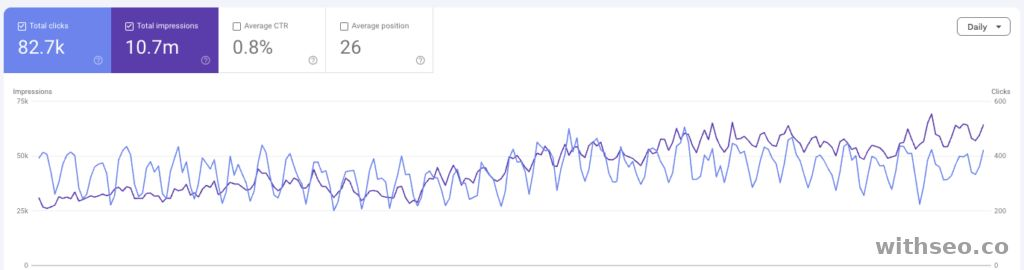
The shape of the growth matters as much as the final number.
Performance stayed relatively flat while the audit, pruning and cleanup work took effect.
Then the trend began climbing through the second half of the engagement.
That is often what foundational SEO work looks like.
The implementation happens first.
The compounding happens afterwards.
Why Impressions Grew Faster Than Clicks
The broader search footprint also meant impressions expanded faster than clicks.
That wasn’t unexpected.
Once the content cluster became cleaner and the technical barriers were reduced, Google could surface the website across a much wider set of relevant queries.
Some of that new visibility naturally came from searches where the pages were not yet ranking at the top.
Some also came from broader, top-of-funnel demand.
So page-one visibility should be viewed as the platform for the next stage of growth, rather than the final result.
The website had earned the ability to compete.
The next opportunity is turning more of that expanded visibility into higher rankings and clicks.
Why the Technical Foundation Mattered So Much
The technical cleanup is the invisible half of this case study.
It is easy for SaaS marketing teams to invest heavily in what appears on the editorial calendar because the output is visible.
You can see the new blog.
You can count the published pages.
You can share the new landing page internally.
Technical cleanup doesn’t always provide the same immediate sense of progress.
But search engines experience the entire website, not just the latest content asset.
Before the cleanup, crawl activity could be spent on broken links, redirect chains, orphan pages and unnecessary URL variations.
After the cleanup, more of that activity could be directed towards the content the business actually wanted to rank.
The content-pruning work told Google:
These are the pages that matter.
The technical cleanup made it easier for Google to reach and understand them.
The two parts reinforced each other.
What This Means for SaaS Teams Chasing a Competitive Category Term
If your blog keeps growing but your most important rankings are not moving, publishing another post may not be the first thing you need.
Audit the Cluster Before Commissioning the Next Article
Start with what already exists.
Map the pages around the category you want to own.
Look for duplicates, weak content, overlapping intent and pages that no longer contribute meaningfully.
Make Every Page Earn Its Place
Score important content on:
- Search intent
- Cannibalization
- Readability
- Performance
Not every old post needs to disappear.
But every indexable post should have a clear reason to remain.
Fix the Crawl Budget Leaks
Check for broken internal links, unnecessary redirect chains, orphan pages, sitemap problems and URL parameters creating noise.
Ranking improvements often depend on technical work that users will never directly see.
Publish Closer to the Buying Decision
Once the cluster is clean, identify what is genuinely missing.
For this client, comparison and decision-stage searches created a clearer opportunity than simply adding more informational content.
The question shouldn’t be:
“What can we publish next?”
It should be:
“What search intent still needs a page?”
Sometimes the Fastest Way to Grow a Blog Is to Make It Smaller First
This remote support software platform wanted to compete for one of the most important terms in its category.
It already had more than 30 posts around the topic.
More content wasn’t the missing ingredient.
First, we pruned the cluster and reduced the overlap.
Then we cleared 1,500+ technical SEO issues across seven high-priority categories.
Only after that did we expand the content library again, this time around much sharper search intent.
Twelve months later, the Remote Support blog cluster had reached an average position of 10.3 — page one.
That is the counterintuitive lesson from this engagement:
Sometimes the fastest path to more organic visibility starts with subtraction.
Prune first.
Fix the foundation.
Then publish where the opportunity genuinely exists.
Page one isn’t the finish line.
But once the foundation is strong enough to compete there, the next stage of compounding can begin.
If your blog keeps growing but your rankings aren’t, the answer probably isn’t more posts. We’ll take a look. Book a free 30-minute SEO teardown