
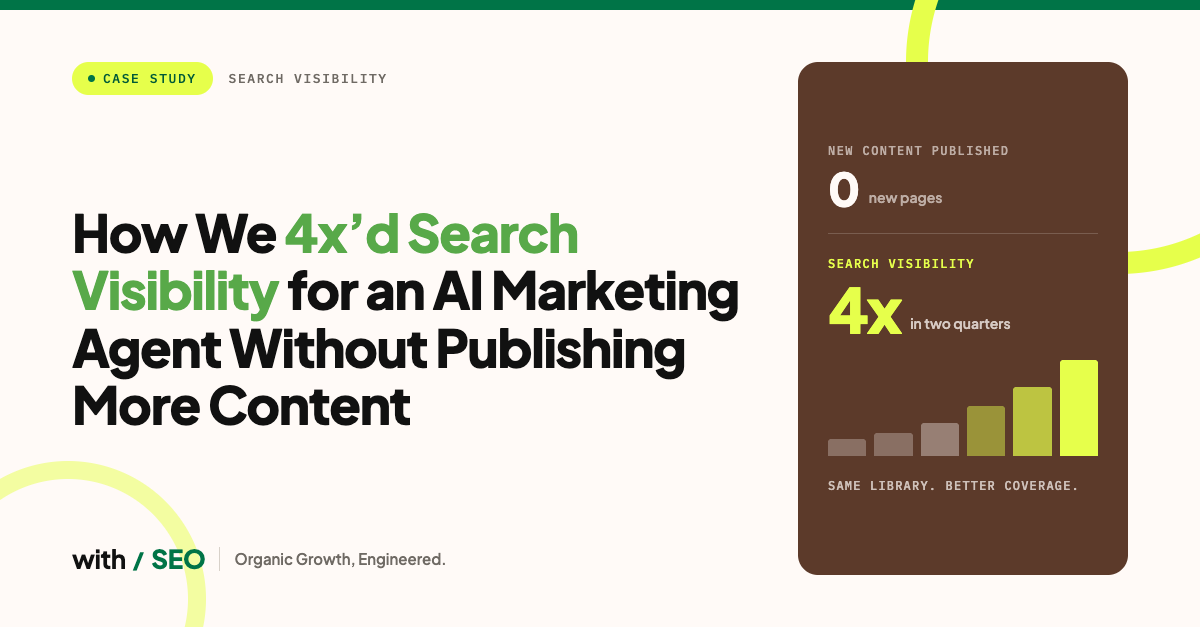
A B2B SaaS company operating in the AI marketing agent space went from 50,400 to 214,000 Google Search impressions in a single quarter.
That’s a 325% increase in search visibility in roughly 90 days.
Clicks also increased from 3,920 to 6,720, a 71% jump.
But we didn’t get there by publishing more content.
In fact, the most interesting part of this B2B SaaS SEO case study is that the client’s average position remained almost unchanged at around 35.
The growth came from somewhere else.
We focused on three things that were already sitting underneath the website: technical SEO, topical clustering and content mapping to search intent.
The objective wasn’t to do more SEO.
It was to make the existing SEO system work better.
About the Client
The client is an AI-native B2B SaaS company operating in the AI marketing agent space.
Like many companies in an emerging AI category, they were competing in a market where search behaviour, terminology and buyer expectations were still evolving.
They already had an organic presence and existing content on the website, but search visibility had started to plateau.
The challenge wasn’t simply to publish more.
It was to build a clearer SEO foundation around what already existed, strengthen how the website communicated its topical expertise and make sure each important page had a defined role in search.
That became the starting point for the engagement.
The Starting Point: A Flat Organic Base
Before we started working on the website, the client was generating roughly 50,000 impressions and 3,900 clicks per quarter.
It wasn’t a website with zero organic presence.
There was already content. There were existing pages targeting relevant topics. Google was already crawling and indexing parts of the site.
But organic growth had reached a point where simply continuing the same approach was unlikely to create a meaningful change.
This is where a lot of SaaS marketing teams default to the same solution:
Publish more content.
Add another 10 blogs to the calendar.
Find more keywords.
Create more landing pages.
Increase publishing frequency.
There is nothing inherently wrong with creating more content. But if the underlying SEO structure is weak, publishing more pages can simply make the existing problems bigger.
You end up with more URLs competing for similar queries, more pages sitting outside a clear topical structure and more content that search engines need to interpret.
So instead of immediately asking:
“What should we publish next?”
We started with:
“What is stopping the content we already have from performing better?”
That changed the direction of the engagement.
Our focus moved from content volume to SEO foundations.
The Three Levers We Pulled
There wasn’t one single change responsible for the growth.
The improvement came from fixing how several parts of the website worked together.
1. We Strengthened the Technical SEO Foundation
The first step was a technical SEO audit of the website.
We looked at areas including:
- Crawlability
- Indexation
- Overall site health
- How pages were being rendered and understood by search engines
Technical SEO for SaaS can easily turn into a checklist.
Find an error.
Fix it.
Close the task.
Move to the next one.
But the objective of technical SEO isn’t simply to reduce the number of warnings inside a crawler.
The real question is whether search engines can reliably access, render, understand and index the pages that matter to the business.
Because even the best content has limited value if search engines struggle to process it properly.
A technically healthy website doesn’t guarantee rankings.
But a weak technical foundation makes every other SEO investment harder.
That includes content, internal linking, topical authority and eventually backlinks.
Our principle here was simple:
A sound technical base is the precondition for everything else.
2. We Turned Scattered Content Into Topical Clusters
The next step was to look at how the existing pages related to one another.
The client already had useful content, but much of it existed as individual pages rather than as part of a deliberately structured topic.
That matters.
A collection of articles around vaguely related keywords isn’t automatically a topical cluster.
A proper topical cluster needs structure.
There should be a clear core topic, supporting subtopics and logical relationships between the pages.
So we reorganised the existing content into clearer topical clusters.
Related pages could now reinforce one another instead of functioning as isolated URLs.
This also helped us understand where the site genuinely had depth and where the coverage was still thin.
For an AI-native SaaS company, this becomes particularly important because the product category itself may still be developing.
Search behaviour changes.
Terminology changes.
Users might describe the same problem in several different ways.
Instead of chasing every individual keyword, the topical cluster strategy gave us a way to build around the broader problems and subjects the company wanted to become associated with.
Clustering turns a scattered collection of pages into a body of authority.
3. We Mapped Every Important Page to Search Intent
The third lever was content mapping.
We wanted every important page on the site to have a clear search purpose.
That meant answering questions such as:
- What query should this page primarily target?
- What is the user actually trying to accomplish when searching that query?
- Is there already another page targeting the same intent?
- Are several URLs competing for effectively the same search?
- Are there important searches where we don’t have the right page at all?
This process helped us identify both gaps and overlaps.
And both matter.
A gap tells you where new content may genuinely be required.
An overlap tells you where creating more content could actually make things worse.
One of the easiest mistakes in SaaS SEO is to find a new keyword in Ahrefs, Semrush or another research tool and immediately create a new article for it.
But keywords aren’t pages.
Multiple keywords may belong to the same search intent and should be handled by one strong page.
At the same time, two keywords that look similar may represent completely different stages of the buyer journey.
That is why content mapping had to happen before we scaled content production.
Our rule became:
Every page with a job, and a job for every page.
The Results: What Changed in 90 Days?
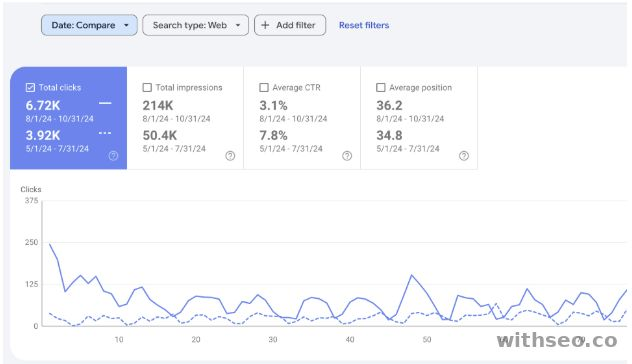
We compared the client’s whole-site Google Search Console performance across two consecutive quarters.
| Metric | May–Jul 2024 | Aug–Oct 2024 | Change |
| Impressions | 50,400 | 214,000 | +325% |
| Clicks | 3,920 | 6,720 | +71% |
| Average position | ~35 | ~35 | Flat |
The clearest change was search visibility.
Impressions grew from 50.4K to 214K.
That means Google started surfacing the website across a significantly wider set of searches.
Clicks followed.
They increased from 3,920 to 6,720, representing a 71% quarter-over-quarter increase.
There is another important detail in these numbers.
Impressions increased much faster than clicks.
And that isn’t something we want to hide behind a growth percentage.
As a website starts appearing for a broader set of queries, many of those new impressions can initially come from lower ranking positions or broader, top-of-funnel searches.
So the search footprint can expand before the click growth catches up.
That is what made the third metric particularly interesting.
The Interesting Part: Average Rankings Barely Moved
Despite the significant increase in impressions and clicks, the site’s overall average position remained at approximately 35.
That might look strange at first.
If visibility increased 4x, shouldn’t average rankings have improved significantly as well?
Not necessarily.
The website was now appearing across many more relevant searches.
But a large portion of that new visibility was still occurring lower on the search results page.
In other words, the growth didn’t come from a small group of keywords suddenly jumping into the top three positions.
The website’s search footprint expanded first.
And this is an important distinction.
SEO progress doesn’t always happen in a perfectly linear sequence where rankings improve first and every other metric follows immediately.
Sometimes the first signal is that Google begins associating the website with a broader set of relevant queries.
Visibility increases.
Then clicks increase.
And as those pages become more competitive, stronger ranking gains can follow.
At the end of this 90-day period, that ranking climb was still largely ahead of us.
The foundation had changed.
The search footprint had changed.
But there was still considerably more room to move up the results page.
What This B2B SaaS SEO Case Study Means for Your Team
There is a simple takeaway from this project:
If organic growth is flat, more content shouldn’t automatically be your first solution.
Before increasing publishing velocity, look at the system you’re publishing into.
Audit the foundation before commissioning more content
Can Google consistently crawl, render and index the pages that matter?
Are there technical issues making the site harder to understand?
If the answer is yes, fixing those problems can increase the value of content you have already invested in.
Give every important page a clear search purpose
You should be able to explain why each strategic page exists from an SEO perspective.
Which query does it serve?
What intent does it address?
Where does it sit within the customer journey?
If two pages are doing the same job, investigate the overlap before adding a third.
Build clusters before you scale content production
Don’t treat keyword research as a list of articles to write.
Group related searches into broader topics.
Decide which page should act as the primary resource and which supporting pages are genuinely necessary.
Then build the relationships between them.
Don’t evaluate SEO progress using rankings alone
Rankings remain important.
But they don’t always tell you the entire story.
In this case, the website’s average position barely changed while impressions increased 325% and clicks increased 71%.
Looking only at average position would have missed most of the progress happening underneath.
Sometimes the Fastest SEO Growth Comes From Fixing What Already Exists
The lesson from this engagement isn’t that SaaS companies should stop creating content.
Content still matters.
The lesson is that publishing more isn’t always the same thing as building more organic visibility.
For this AI marketing agent, the immediate opportunity wasn’t another batch of blog posts.
It was fixing the foundation underneath the existing website.
Technical SEO made it easier for search engines to process the site.
Topical clustering created clearer relationships between pages.
Content mapping gave every important URL a defined search purpose.
Within one quarter, impressions increased from 50.4K to 214K and clicks grew from 3.9K to 6.7K.
And average position was still sitting around 35.
The search footprint had expanded.
The foundation was stronger.
And the climb up the results page was still ahead.
If your organic growth has plateaued and you’re not sure whether the answer is more content or better SEO foundations, we’ll take a look. Book a free 30-minute SEO teardown.